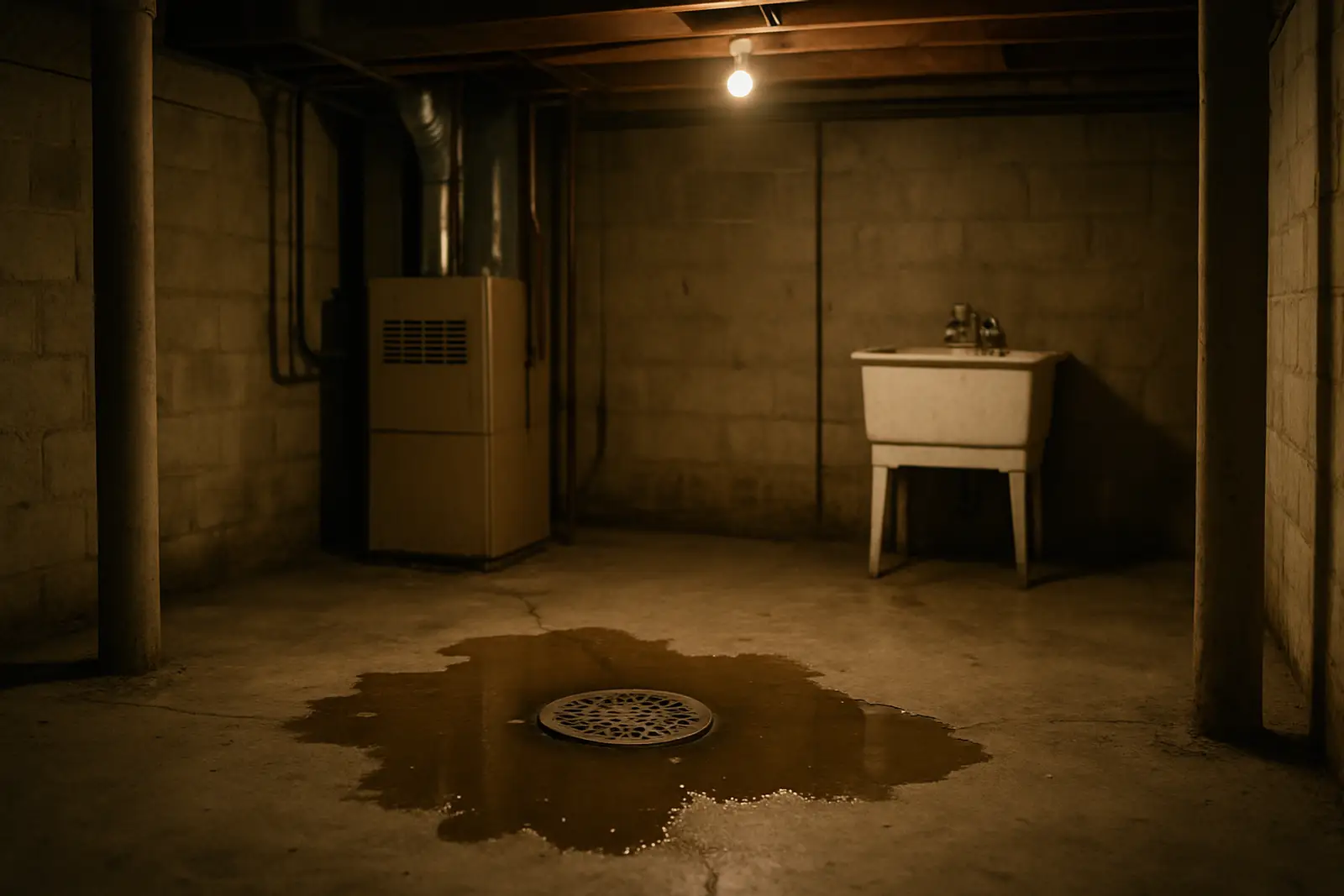
Sewer backup in the house: what to do right now
- 1
Stop sending water down
Turn off the washing machine and dishwasher, and ask everyone in the house to stop flushing and showering. A home sewer backup gets worse with every gallon that goes in.
- 2
Stay out of standing sewage near power
If the water is touching a furnace, water heater, extension cord or outlet, keep out of it and leave the breaker panel alone unless you can reach it from somewhere dry.
- 3
Check whether the street is involved
Look out at the neighbors, especially after rain. If other homes have water too, report it to the city or sewer district as well as calling a plumber.
- 4
Call for main line clearing
Tell the plumber sewage is coming up, from which drain, and whether you have a cleanout. That one sentence decides which machine comes off the truck.
What causes a main sewer line backup
| Cause | How it usually shows up |
|---|---|
| Main line clog (wipes, paper, grease) | Backs up when the house uses water, stops when it doesn't |
| Tree roots in the lateral | Slow drains for weeks, then a sudden stoppage, often in late summer |
| City main surcharge | Water comes up during a storm even with nothing running in the house |
| Collapsed or broken lateral | Backups return within days of a clearing, sometimes with a soggy spot in the yard |
| Sag (belly) in the line | Repeat clogs at the same distance from the cleanout |
| Blocked or stuck backwater valve | Backup in a home that has a valve, often after a storm |
Main line clog: the most common sewage backup
Most sewage backups in a single house come from a blockage somewhere in the main drain or the lateral under the yard. Every fixture in the house drains into that one pipe, so when it stops, the water looks for the lowest opening it can find. In a home with a basement, that's the floor drain or a basement toilet. In a slab house, it's usually the tub or shower on the ground floor. Wipes, paper towels, feminine products and grease from the kitchen are the usual culprits, and they tend to pile up where the pipe changes direction or where a joint has shifted.
The tell is timing. If water comes up only when someone runs a fixture, and drains back down slowly when everything is off, the line is clogged rather than overloaded from the street. Clearing a main sewer line from the cleanout is the fix, and a plumber can usually have it flowing in an hour or two.
Tree roots and collapsed laterals
Clay laterals from before the 1970s are joined every few feet, and those joints are where roots get in. Fine hair roots grow into a dense mat that catches paper, and the line goes from slow to stopped in one evening. Roots are the reason so many older neighborhoods see backups in late summer and fall, after a season of growth. Root cutting clears them, and jetting cleans the walls afterward, but they come back unless the joints are sealed.
A collapsed or badly offset section is a different problem. The cable may get through and the water may drain, but the broken pipe catches debris again within days. If a backup returns quickly after a clearing, ask for a camera run. Orangeburg pipe, the tar paper pipe used in some homes built from the late 1940s to the early 1970s, is especially prone to flattening and collapse.
City main surcharge during storms
Sometimes nothing is wrong with your pipe at all. In cities with combined sewers, or old sanitary sewers that take in rainwater through cracks and manholes, a hard storm can fill the public main faster than it drains. When the main is full, sewage pushes back up every lateral on the street and spills out of the lowest drain in each house. Cabling your line won't help, because the blockage isn't in it.
If your backup started during heavy rain, while no one was using water, call the city or sewer district and report it. Take photos with the time showing. Some utilities track these reports to decide where to invest, and some run programs that help homeowners in flood-prone areas pay for protection. Once the storm passes and the main drains, the water in your basement usually recedes on its own, and then the cleanup starts. Older combined-sewer cities see this most, which is why Detroit basement sewer backups after summer storms are such a familiar story there.
Who to call for a sewer backup
| Situation | First call | Then |
|---|---|---|
| Only your house, water rises when fixtures run | A plumber for main line clearing | Camera inspection to find the cause |
| Several homes on the street, during rain | The city or sewer district | A plumber if water doesn't recede after the storm |
| Sewage on a finished basement floor | A plumber to stop the source | A water damage restoration company for cleanup |
| Home on a septic system | A plumber or septic service | Tank pumping or drain field check if the line is clear |
| You rent the home | Your landlord or property manager | Your renters insurance about belongings |
Drain clearing vs sewage cleanup
People searching for sewer backup cleaning services near them often mean two different jobs, and it helps to keep them apart. Drain clearing is plumbing: opening the main line so the house drains again and finding out why it stopped. Sewage cleanup is restoration: extracting the contaminated water, removing wet carpet and drywall, disinfecting and drying the space so mold doesn't follow. A plumber does the first. A restoration company, often the one your insurer works with, does the second.
On a small backup onto a concrete basement floor, many homeowners do the cleanup themselves with gloves, boots, eye protection, a squeegee and a disinfectant. On anything larger, especially sewage that reached carpet, wallboard or a finished room, the restoration crew is worth it. Either way, the line has to be cleared first. There's no point cleaning a floor that will flood again the next time someone flushes.
Backwater valves for sewer backup prevention
A backwater valve sits in the main line, usually in the basement floor near where the pipe leaves the house or in a pit outside. Sewage flows out through it normally. If the flow reverses because the street main is surcharged, a flap closes and keeps that water out of the house. For homes that have flooded from storm surcharges, it's the single most useful upgrade.
Installing one usually means cutting the basement floor or digging outside, setting the valve with an access cover, and in many cities pulling a plumbing permit. Most installations land between $900 and $3,000, depending on depth, the floor and whether it goes inside or out. The valve needs a look once or twice a year so debris doesn't keep the flap from sealing. While the valve is closed during a storm, avoid running water inside, since your own drains have nowhere to go until it reopens.
Sewer backup costs
| Work | Typical range |
|---|---|
| Main line cleared from a cleanout | $200–$500 |
| Main line cleared through a pulled toilet | $300–$650 |
| Root cutting in the lateral | $250–$650 |
| Hydro jetting the main line | $350–$900 |
| Camera inspection after clearing | $150–$400 |
| Cleanout installation | $600–$2,000 |
| Backwater valve installation | $900–$3,000 |
| Spot repair of a broken section | $1,500–$4,500 |
What raises the cost of a sewage backup
- No accessible cleanout, so the plumber works through a toilet
- A long lateral or one that runs under a driveway to the street
- Roots or grease that need a second pass or jetting
- Arrival at night, on a weekend or on a holiday
- Damage found on camera that needs a repair, not just a clearing
- Restoration work on finished floors and walls, which is billed separately
Insurance and sewer backup
Standard homeowners policies often exclude damage from water that backs up through drains, unless a sewer or water backup endorsement was added. The clearing itself is almost never covered, since insurers treat it as maintenance. Call your agent before tossing anything, photograph the water line on walls and belongings, and keep the plumber's invoice and any camera footage. If you've had one backup and your policy lacks the endorsement, it's worth asking what adding it would cost. For a step-by-step on the first hour, see what to do when the sewer backs up.
Sewer backup: common questions
Is a sewer backup an emergency?+
Yes, if sewage is coming into the house. Stop using water and call. A slow drain can wait for morning; raw sewage on the floor shouldn't.
Will a plumber clean up the sewage too?+
Most plumbers clear the line and leave the area safe, but full sewage cleanup of carpet, drywall and belongings is usually done by a water damage restoration company.
Why does my basement floor drain back up when it rains?+
Usually because the public sewer fills during the storm and pushes water back up the lateral. A backwater valve is the standard fix.
Can I use the toilet during a sewer backup?+
No. Everything you flush adds to the water coming up. Wait until the line is cleared and the plumber has tested it.
How do I keep it from happening again?+
Find the cause on camera. Roots need cutting or lining, a broken section needs repair, storm surcharges need a backwater valve, and wipes need to go in the trash.